By Yoges Raja · November 2026

Pallets of cartons in a warehouse. A count is only as good as the labels, locations and units you count them by. Photo: Wikimedia Commons
Why closing is usually the wrong answer
A full shutdown count is expensive in a way that rarely appears in the accounts: a day of lost sales in the last week of December, staff paid overtime to count, and a shop full of customers who went elsewhere. For a retailer turning over RM3 million a year, a December Saturday is worth more than the accuracy a shutdown buys.
The alternative is not a less accurate count. It is a count designed around what actually goes wrong. Most inventory error sits in a small number of high-value lines and in a handful of locations where goods are put down rather than put away. Count those properly while trading, and count the rest over a longer window.
Count by value, not alphabetically
Sort your stock list by annual value consumed — quantity times cost — and split it into three bands. The top 20 per cent of lines typically carries 70 to 80 per cent of the value; that band is counted in full, twice, by different people. The middle band is counted once. The long tail is counted by location sweep, verifying quantity on the shelf against the system rather than counting every unit.
Do the same with locations. Your racks, your cold room, your display, your returns cage and the corner where staff leave pending deliveries are five different inventories with five different error rates. The returns cage is almost always the worst, because nobody owns it.

A distribution centre at Bukit Beruntung. A modern DC counts continuously by location; a small business can borrow the method without the building. Photo: Wikimedia Commons
How to count while trading
Four mechanics make this work. First, a cut-off time. Nothing moves out of a counted section after it is counted, and nothing moves in. Mark the section with tape or a card, and put one person in charge of the boundary. Second, two people per section: one counts, one records, and neither is the person responsible for that stock. Third, count in the unit you sell in, not the unit you buy in, and convert once at the end. Fourth, count the fast movers last — after the shop has closed on the counting day — and freeze only those lines.
If you sell on a POS system, take a system snapshot at the cut-off and record the timestamp. Every later discrepancy is measured against that moment, not against whatever the system says three days later.
Reconciling, and writing off what is genuinely gone
Reconcile by line: opening quantity, plus purchases received, minus sales recorded, equals expected quantity. Compare that to the count. A variance is one of four things — counting error, unrecorded sale, unrecorded receipt, or shrinkage. Recount before you conclude anything; a large share of "shrinkage" in small businesses is a second count that should have happened.
Write-offs need a paper trail, and the trail is what makes the figure defensible: the count sheet signed by both counters, the reconciliation showing the arithmetic, a reason for each material adjustment, the approval of someone senior, and physical evidence — photographs of damaged or expired stock, a disposal note, a supplier credit note where one exists. Do not net a write-off against purchases; show it.
Confirm before you post: the treatment of write-downs and the evidence your auditor and LHDN will want for them; whether slow-moving stock must be valued at net realisable value rather than cost; and how your accounting system records the adjustment. Your auditor is the right person to ask, and the answer depends on whether you report under MPERS or MFRS.
What the number actually feeds
Closing inventory is not a footnote. It sets cost of sales, which sets gross profit, which sets the tax you pay. Overstate it and you understate cost of sales and overpay nothing — you underpay tax this year and overpay next. Understate it and you reduce this year's profit legitimately, which is why the documentation matters more than the number.
Valuation policy comes first. Under MPERS Section 13, private entities measure inventories at the lower of cost and net realisable value, using first-in-first-out or weighted average cost; last-in-first-out is not permitted. If your policy is not written down, your count produces a quantity, not a value — and a quantity without a policy is an argument waiting to happen.
One clarification worth stating plainly, because it is widely misunderstood: stock is not a capital allowance item. Capital allowances apply to qualifying fixed assets — plant, machinery, equipment, vehicles — which live on a separate register. The stock count feeds cost of sales and the balance sheet; the fixed asset register is a different exercise with its own verification.
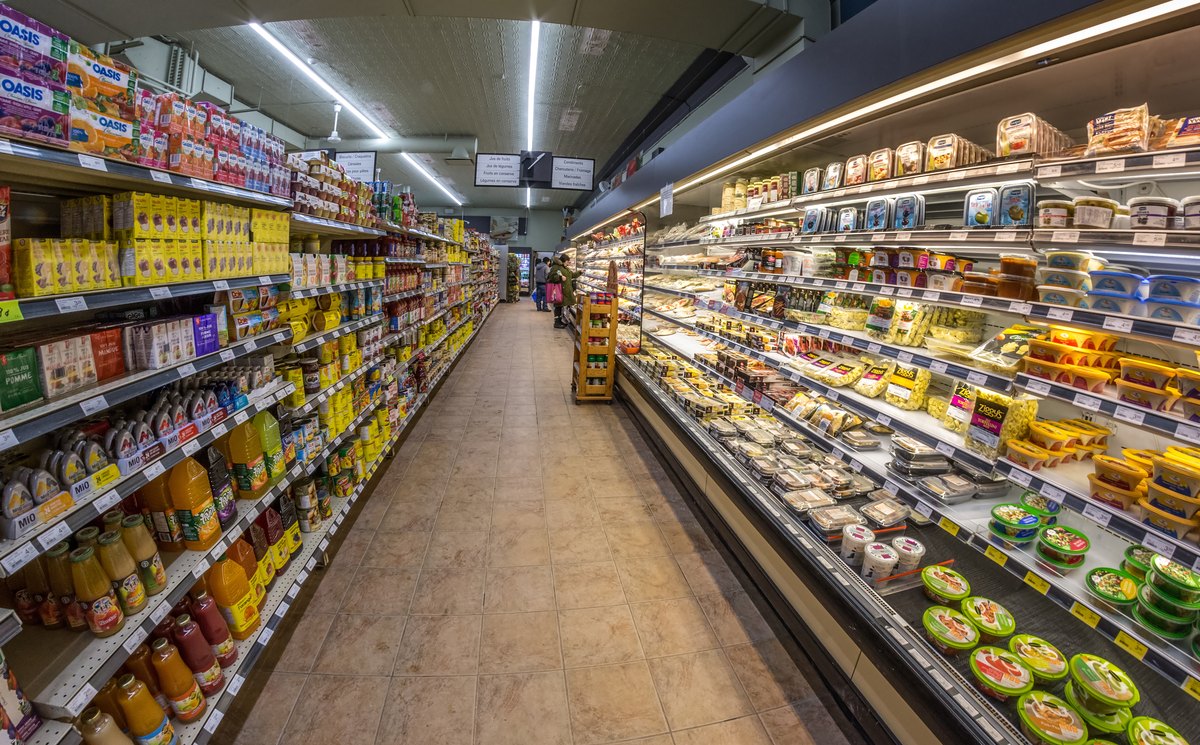
A supermarket aisle in Quebec City. The refrigerated cabinet on the right is a different inventory with a different error rate from the dry shelves. Photo: Wikimedia Commons
Where e-invoice fits — and where it doesn't
An e-invoice records a sale; it does not record a stock movement. That distinction matters at year-end, because the count is how you prove that the sales you invoiced match the goods that left the building. A gap between purchases, invoiced sales and physical stock is the thing a reviewer will ask about, and unrecorded sales are the least comfortable explanation.
The technical rules have moved twice this year. Taxpayers with turnover up to RM5 million have been in scope since 1 January 2026, while those below RM3 million are exempt under the timeline LHDN updated on 30 August 2026, with an interim relaxation period for the RM5 million band to 31 December 2027. Separately, from 24 October 2026 MyInvois enforces a 26-digit maximum on every monetary amount field and a 12-character limit on passport-type identification in the Production environment, per LHDN's SDK 1.0 release note dated 6 August 2026. Neither rule changes how you count. Both change how your system stores what you count.

Checkout lanes at a hypermarket in Kota Damansara. Every trolley that passes is a stock movement — which is why the count has to be tied to a timestamp. Photo: Wikimedia Commons
The one-page checklist
| Step | What good looks like |
|---|---|
| Before the count | Valuation policy in writing; stock list sorted by value; locations mapped; cut-off time published |
| During | Two people per section; section sealed after counting; system snapshot timestamped |
| Reconciliation | Opening + purchases − sales = expected, by line; variances recounted before adjustment |
| Adjustment | Signed count sheets, reason per material item, senior approval, photographic evidence |
| After | Adjustment posted once, documented, and reflected in the accounts and the e-invoice record |
Conclusion
You can count without closing. Sort by value, count by location, set a cut-off, use two people who do not own the stock, and reconcile line by line before you post a single adjustment. The discipline is in the paperwork, not the shutdown.
Write the valuation policy before you count, not after — lower of cost and net realisable value, FIFO or weighted average, and a rule for obsolete stock that someone other than the buyer applies.
Then use the result. A count that produces an accounting figure and no management action is an expensive formality. The same numbers tell you which lines to stop buying, which supplier short-delivers, and where your shrinkage actually lives.
Frequently Asked Questions
1. Do I have to close my business to count stock?
No. Count high-value lines after trading on your chosen day and everything else by location over a longer window, with a fixed cut-off and a system snapshot. The count only has to be defensible, not simultaneous.
2. How often should I count?
Annually at minimum for the accounts. Most SMEs benefit from counting the top 20 per cent of lines by value monthly and the remainder quarterly, which catches error while it is still traceable.
3. Can I value stock at selling price?
No. Under MPERS Section 13, inventories are measured at the lower of cost and net realisable value, using FIFO or weighted average cost. Selling price is only relevant as evidence of net realisable value.
4. What records should I keep for a write-off?
The signed count sheet, the reconciliation, the reason for each material adjustment, senior approval and physical evidence such as photographs or a disposal note. Keep them with the year-end file, not in a drawer.
5. Does the 26-digit MyInvois rule affect my stock count?
Not the count itself. From 24 October 2026 MyInvois limits monetary amount fields to 26 digits and passport identifiers to 12 characters, which is a system configuration matter. Check that your POS or accounting software complies before year-end.
Yoges Raja covers digitalisation, systems and business operations for SMEBuddies. He writes about the unglamorous mechanics that decide whether a small business can see its own numbers — stock accuracy, till and POS configuration, invoice flows and the handover between the shop floor and the accounts. His focus is on processes a firm can run with the staff it already has.
Year-End Stock Count Without Closing the Shop