By Low Kok Ping · November 2026

A calculator on a desk. A 25 basis point move is small in percentage terms and specific in ringgit terms — which is why it is worth computing rather than fearing. Photo: Wikimedia Commons
What happens tomorrow, and what has not changed
The Monetary Policy Committee holds its sixth and final scheduled meeting of 2026 on 5 November, with the statement usually released around 3pm. The Overnight Policy Rate has been 2.75% since 9 July 2025, when it was cut by 25 basis points from 3.00%. It has been held at every meeting since — seven consecutive holds, the most recent on 3 September 2026 (Bank Negara Malaysia).
What the September statement said matters more than the number. The committee described the stance as consistent with price stability and sustainable growth, noted headline and core inflation averaging 1.8% and 2.0% in the first seven months of 2026, and said it would "remain vigilant to cost pressures" given the Middle East conflict's effect on energy prices.
Why the market is genuinely split
September's consumer price index rose 1.8% year on year, below August's 1.9% and below the 1.9% median forecast in a Bloomberg survey, which on its own argues for waiting (The Edge Malaysia, October 2026). The growth side argues the other way: the economy expanded 5.7% in the first half of 2026 and the advance estimate for the third quarter, published on 16 October, came in at 5.3%.
Among the houses, UOB Global Economics and Markets Research expects a 25 basis point hike tomorrow to 3.00%, a call it repeated in an October note; Nomura and ANZ have made similar calls for November. RHB Research expects the move in the first half of 2027 instead, and TA Research expects no change this year with a possible 25 basis point rise in 2027. In the Reuters poll before the September meeting, all but two of 31 economists expected a hold; of the 26 who gave longer forecasts, 19 saw 2.75% through the end of 2027.
Translation: nobody knows, and anyone who tells you otherwise is selling something. Plan for both.
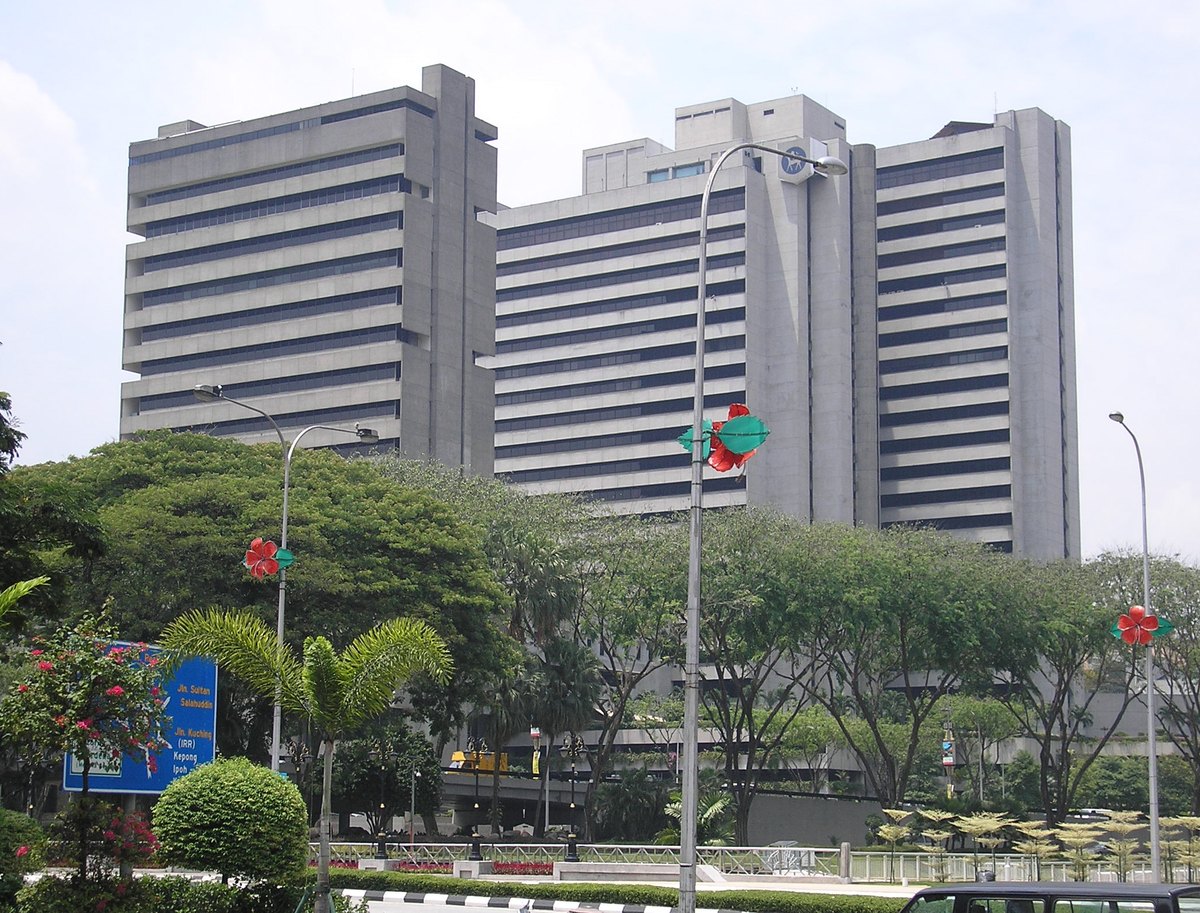
Bank Negara Malaysia's headquarters in Kuala Lumpur. The committee's statement is published on the central bank's site shortly after the meeting. Photo: Wikimedia Commons / Two hundred percent, CC BY-SA 3.0
How 25 basis points reaches your loan
New floating-rate facilities in Malaysia are priced off the Standardised Base Rate, which is set equal to the OPR and moves by exactly the same amount whenever the OPR changes. Your rate is the SBR plus a spread the bank sets for your risk, sector and collateral. If your spread is 2.00 percentage points, you pay 4.75% today; a 25 basis point hike makes it 5.00% with the spread unchanged.
Three complications. First, older facilities may still be priced off the Base Rate, Base Lending Rate or Base Financing Rate, which move with funding costs but not always by the same amount. Second, overdrafts are charged on the drawn balance, so a fully drawn RM250,000 overdraft is more sensitive than its headline rate suggests. Third, hire purchase is fixed-rate: an existing agreement does not reprice, although new HP pricing can.
The arithmetic, in ringgit
| Facility | Today at 4.75% | After +25bp at 5.00% | Monthly | Annual | Extra over term |
|---|---|---|---|---|---|
| RM300,000, 5 years | RM5,627.07 | RM5,661.37 | +RM34.30 | +RM411.56 | +RM2,057.79 |
| RM500,000, 7 years | RM7,008.37 | RM7,066.95 | +RM58.59 | +RM703.04 | +RM4,921.25 |
| RM1,000,000, 10 years | RM10,484.77 | RM10,606.55 | +RM121.78 | +RM1,461.33 | +RM14,613.26 |
| RM250,000 overdraft, fully drawn | RM1,250.00 interest | RM1,302.08 interest | +RM52.08 | +RM625.00 | n/a |
These are reducing-balance instalments computed at 4.75% and 5.00%, with the rate expressed as SBR plus a 2.00 percentage point spread, and the overdraft at 6.00% rising to 6.25%. No fees, no compounding quirks, no changes to tenure.

Kuala Lumpur at night. The ringgit and the policy rate move in the same conversation, which is why an imported input cost and an instalment can rise together. Photo: Wikimedia Commons
What the numbers actually mean
Thirty-four ringgit a month is not a crisis. That is the honest reading, and it is why a 25 basis point move should not change a sound investment decision. What it does change is a thin margin: RM412 a year on a RM300,000 loan is roughly the gross profit on a few thousand ringgit of sales for a distributor, and it arrives whether or not trade improves.
The larger exposure is the sequence. If this week is the first of several moves into 2027, a business that borrows RM1 million on a floating rate pays about RM1,461 more in the first year and roughly RM14,600 more across a ten-year term. That is a decision you can plan for; a surprise is not.
Ask your bank one question before the announcement: if the rate moves, does the instalment change or does the tenure stretch? Many facilities hold the instalment and extend the repayment period, which protects your monthly cash flow and quietly costs more interest.
Four things to do before you sign anything
Read the reference rate clause. Find out whether your facility is priced off the SBR, the BR or the BLR, and what the spread is. If you cannot find it in the letter of offer, ask in writing.
Price the fixed option, honestly. A fixed rate is insurance, and insurers charge for risk. If the fixed rate on offer is more than about 75 basis points above floating, you are paying for certainty you may not need — but if your margin cannot absorb a second hike, that is a fair price.
Sequence your borrowing. If you are planning expansion capex in the first quarter of 2027, do not stack a new variable-rate facility on top of an existing one in the same quarter. Either size it smaller, or take the fixed option for the portion you cannot reprice.
Check the cheap money first. The SME Stabilisation Relief Facility is capped at 3.75% a year including the guarantee fee, up to RM750,000 over five years, for working capital, until 30 June 2027 or full utilisation. On RM750,000 over five years that costs RM13,727.94 a month against RM14,239.49 at 5.25% — a saving of RM511.55 a month, or RM6,138.59 a year. It requires a viable Malaysian-owned SME affected by trade and supply chain disruption since March 2026, and does not refinance existing debt.

Hands guiding a component through a machine. Equipment bought on a five-year term loan is where a quarter-point move compounds into a real number. Photo: Wikimedia Commons
Assumptions and caveats: the instalments above assume a reducing-balance term loan, a fixed spread, no fees and no change to tenure. Banks price off their own base rates and can change spreads on new facilities, and Islamic financing uses a profit rate rather than an interest rate, so the mechanics differ. Your letter of offer governs. Confirm the current OPR and your facility's reference rate with Bank Negara Malaysia and your bank before making a decision.
Conclusion
A 25 basis point move is a small number that behaves like a large one when your margin is thin and your facility is big. Compute your own version of the table above before tomorrow afternoon, using your actual outstanding balance and remaining tenure.
Then decide what you would do differently if the answer is 3.00% rather than 2.75%. If the answer is "nothing", you are not exposed and can ignore the announcement. If the answer is "reprice the contract" or "delay the equipment", you have a day to act.
And if you are borrowing for working capital rather than expansion, compare the 3.75% facility against your bank's floating rate before you accept a hike as inevitable.
Frequently Asked Questions
1. Does a higher OPR raise my existing hire purchase instalment?
Normally not. Hire purchase in Malaysia is priced at a fixed rate agreed at signing, so an OPR change does not alter an existing agreement. New hire purchase pricing can change, and floating-rate term loans and overdrafts do reprice.
2. How quickly does my loan rate change after the announcement?
Banks typically announce revised base rates within days and apply them from a stated effective date, often about a week later. Check your bank's notice rather than assuming the change applies from the announcement date.
3. Is 25 basis points really worth restructuring a loan for?
Usually not on its own, because restructuring fees and lock-in penalties can exceed the saving. It matters when you are already refinancing, or when several moves are expected over 2027.
4. Can I switch an existing floating loan to a fixed rate?
Sometimes, but it usually means a new facility or a conversion with fees. Ask your bank for the conversion cost and the fixed period before comparing it with the floating alternative.
5. What is the SME Stabilisation Relief Facility capped at?
A maximum financing rate of 3.75% a year including the 0.5% guarantee fee, up to RM750,000, over up to five years, for working capital. It is open until 30 June 2027 or full utilisation, and applications go through participating banks.
Low Kok Ping covers financing, cash flow and grants for Malaysian SMEs at SMEBuddies. He writes about borrowing costs, facility structures and the arithmetic behind a repayment schedule, with the aim of making a bank's letter of offer readable to an owner who did not draft it. He is sceptical of forecasts and fond of amortisation tables.
BNM Decides Tomorrow: What a Rate Move Really Costs Your Instalments